
📍 Quick Answer

To adjust bike brakes, first check whether your brake lever pulls too close to the handlebar (too loose) or is hard to squeeze (too tight). For caliper and V-brakes, turn the barrel adjuster counterclockwise to tighten cable tension. For disc brakes, loosen both caliper mounting bolts, squeeze the lever to centre the pads on the rotor, then retighten. Brake pads should sit parallel to and centred on the braking surface and must not be worn past the wear indicator line.
If your brakes are soft, squeaky, or slow to respond, there’s a good chance they just need a simple adjustment. The good news is that you don’t need to take your bike to a shop every time. With a couple of Allen keys and about 15 minutes, you can dial in most brake systems yourself.
This guide covers the four most common bike brake types: caliper brakes, V-brakes (linear-pull), cantilever brakes, and disc brakes (both mechanical and hydraulic).
We will go through each one step by step.
Also Read:
- What are the different types of bike brakes?
- Why are my bike brakes squeaking?
- How long do bicycle brake pads last?
- Centerlock vs 6-bolt disc brakes
What You Need Before You Start
For most brake adjustments, you’ll need:
- 4mm and 5mm Allen keys (hex wrenches)
- A flat-head screwdriver
- A flashlight (helpful for checking disc brake pad clearance)
- Fine-grit sandpaper (for resurfacing worn pads)
- Brake cable cutters (only if replacing cables)
- Isopropyl alcohol and a clean rag (for cleaning disc rotors — never use oil or WD-40 on disc brakes)
📍 📌 How to know if your brakes need adjusting (not replacing)
Pull each brake lever firmly. The brake should engage with at least 1.5 to 2 finger-widths of space between the lever and the handlebar. If the lever hits the bar, the cable is too loose. If you can barely squeeze the lever, it’s too tight. Also look at your pads — if you can see the wear indicator line (a groove or mark on the pad surface), it’s time for replacement, not adjustment. New pads cost $10–30 and take about five minutes to swap.
How to Adjust Caliper Brakes
Caliper brakes are the classic single-pivot or dual-pivot design found on most road bikes. They clamp onto the rim from both sides. If you’ve got drop handlebars, this is almost certainly the brake type you’re working with.
Step 1: Check and adjust brake pad alignment
Pull the brake lever and watch where the pads hit the rim. A correctly aligned pad sits centered on the braking track — not touching the tire above, and not slipping below onto the spokes. Hold the lever down and use your Allen key to loosen the brake pad fixing bolt. Reposition the pad so it’s parallel to the rim, then retighten.
Step 2: Set cable tension with the barrel adjuster
The barrel adjuster is the small cylindrical dial where the cable housing enters the brake lever on the handlebar. Turn it counterclockwise to tighten the cable (pads move closer to the rim) or clockwise to loosen it (pads move away). Small turns make a big difference — try a quarter-turn at a time.
Step 3: Check and center the caliper
Spin your wheel and watch whether one pad drags against the rim before the other. To center it, find the small centering screw on the side of the caliper body. Tightening it clockwise pushes that arm away from the rim; counterclockwise pulls it in. The goal is an equal gap on both sides.
Step 4: Test and fine-tune
Squeeze the lever firmly several times. The pads should make contact and release cleanly. The lever should stop about 1–1.5 inches from the handlebar when the brake is fully engaged. If the wheel wobbles side to side (the wheel is out of true), that’s a wheel issue — not a brake issue.
📍 Quick fix: brakes that won’t center
If one pad always rubs the rim even after adjustment: check that the wheel is fully seated in the dropouts (push it down firmly and retighten the quick release). A wheel that’s slightly off-center will make the brake look misaligned even when it isn’t.

How to Adjust V-Brakes (Linear-Pull Brakes)
V-brakes (also called linear-pull or direct-pull brakes) are the two tall arms you’ll find on most hybrid bikes, commuters, and older mountain bikes. They’re powerful, cheap to maintain, and fairly easy to work on.
Step 1: Inspect the pads
V-brake pads are longer than caliper pads and attach with a series of washers that let you angle them precisely. Note the order of the washers before removing anything — photograph it if needed. The pad should sit flat and parallel to the rim surface, with about 1mm of clearance below the tire sidewall.
Step 2: Toe in the pads to stop squealing
Squealing V-brakes usually need ‘toe-in’ — the front of the pad should touch the rim just before the rear end does. Loosen the pad fixing bolt, slip a thin card (about 1mm thick) behind the back end of the pad, then retighten with the card in place. Remove the card. This gives you the slight angle that eliminates squeal in most cases.
Step 3: Balance spring tension between the two arms
At the base of each V-brake arm is a small spring tension screw. If one arm returns faster than the other, the brake won’t release evenly. Tighten the screw on the slow side to increase spring tension. Both arms should spring back at the same speed when you release the lever.
Step 4: Adjust cable tension
Use the barrel adjuster at the lever to fine-tune. With V-brakes, the cable passes through a metal ‘noodle’ that hooks over the arm. If the lever pulls all the way to the bar, you may need to undo the cable anchor bolt on one arm, pull more cable through, and retighten.
Also Read:
How To Adjust Cantilever Brakes
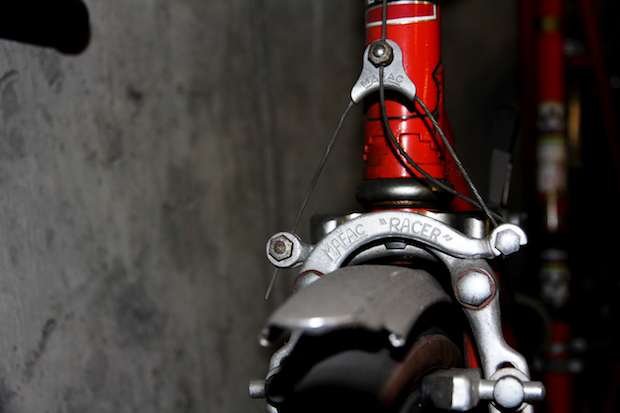
Cantilever brakes are the older cousin of the V-brake. You’ll find them on cyclo-cross bikes and older touring and mountain bikes. They look similar to V-brakes but the arms are shorter, and they connect via a straddle wire or yoke across the top. They’re a bit more fiddly to adjust, but the process is similar.
Step 1: Check the straddle wire
The straddle wire runs across the top of both arms and attaches to the main brake cable. Its height affects braking power and feel. A higher straddle wire gives more modulation; a lower one gives more power. If yours is fraying or stretched, replace it before adjusting anything else.
Step 2: Set pad height and angle
The pads should sit fully on the braking surface of the rim — not on the tire or below onto the spokes. Use the washers to angle them slightly toed-in (front of pad contacts first). Hold the brake lever in while you tighten the pad bolts to lock in the position.
Step 3: Center the arms
Like V-brakes, cantilevers have a small spring tension screw at the base of each arm. Adjust these until both pads contact the rim simultaneously and release evenly.
Step 4: Clean the pivots if arms feel sticky
Remove the arms entirely with your Allen key. The pivot posts should be clean and smooth. If there’s dirt or light corrosion, clean it off and apply a tiny amount of grease to the pivot before reinstalling. Dirty pivots are the single most common cause of sluggish cantilever brakes.
How to Adjust Disc Brakes
Disc brakes are standard on most modern mountain bikes, gravel bikes, and a growing number of road bikes. There are two types: mechanical (cable-actuated) and hydraulic (fluid-actuated). The alignment process is similar for both.
📍 Mechanical vs Hydraulic — what’s the difference for adjustment?
Mechanical disc brakes are adjusted the same way as cable-actuated rim brakes — via barrel adjusters and pad-adjusting knobs. Hydraulic disc brakes are self-adjusting as pads wear, but the caliper alignment process is identical. If hydraulic brakes feel spongy or the lever goes to the bar, they may need bleeding — that’s a separate job.
Step 1: Check the wheel is fully seated
With the bike on the floor, loosen the quick release (or axle), apply downward pressure on the frame to seat the wheel fully, and retighten. A wheel that’s slightly off-center makes the rotor look misaligned when it isn’t. This single step fixes a surprising number of disc brake rub problems.
Step 2: Identify the rub
Elevate the bike and spin the wheel slowly. Shine a light through the caliper to see where the pads are relative to the rotor. Is both sides rubbing, or just one? If the rotor is bent, you’ll see it wobble. A bent rotor needs to be carefully straightened or replaced — you can’t fix that with caliper adjustment.
Step 3: Loosen the caliper and squeeze the lever
This is the key step for mechanical and hydraulic disc brakes alike. With a 5mm Allen key, loosen both caliper mounting bolts until the caliper can slide side to side slightly. Then squeeze the brake lever firmly and hold it. While holding the lever, retighten both mounting bolts alternately. Release the lever. The caliper is now centered around the rotor by the lever pressure.
Step 4: Spin and check
Spin the wheel. If there’s still light rubbing, loosen one bolt slightly and push the caliper body in the direction of the rub until both sides clear. Retighten. Most calipers need 5–8 Nm on the mounting bolts — if you have a torque wrench, use it. Without one, firm but not aggressive is the target.
Step 5 (mechanical disc only): Adjust pad clearance
Mechanical disc brake calipers typically have pad-adjusting knobs or screws. Once the caliper is aligned, use these to set an even 0.5mm–1mm gap between each pad and the rotor. Too close and pads will drag; too far and lever travel increases. Start with the inner pad, then the outer.
Common Brake Problems and What They Mean
| SYMPTOM | LIKELY CAUSE | QUICK FIX |
| Lever hits the handlebar | Cable too loose or pads too far from rim | Turn barrel adjuster counterclockwise 2–3 turns |
| Brakes squeal on every stop | Pads glazed, contaminated, or not toed-in | Sand pads lightly, clean rim with alcohol, add toe-in |
| Disc brake rubs constantly | Caliper misaligned or wheel not seated | Re-seat wheel, re-align caliper using lever-squeeze method |
| One pad drags on disc | Sticky piston (hydraulic) or pad too close | Clean pistons with isopropyl alcohol; back off pad adjuster |
| Soft or spongy lever feel (hydraulic) | Air in brake fluid lines | Brake bleed required — not an adjustment job |
| Pads wear out quickly | Contamination with oil or grease | Replace pads; clean rotor and don’t use lubricants near disc |
| Brake shudders under hard braking | Loose caliper bolts or bent rotor | Check torque on caliper bolts; inspect rotor for warping |
When to Replace Your Pads Instead of Adjusting
Adjustments only go so far. If your pads have worn past the wear indicator line, replacing them is the only real fix. Worn pads are softer, take longer to bite, and can score your rim or rotor if you let it go too long.
As a general rule: rim brake pads (caliper, V-brake, cantilever) typically last 1,000–3,000 miles on dry roads. Disc brake pads last 500–2,000 miles depending on conditions — wet riding and mountain bike terrain eat pads much faster. If you ride in the rain regularly, check your pads every few months.
Also Read:
- How long do bicycle brake pads last?
- When to replace bike tires
- Different types of bike brakes explained
